
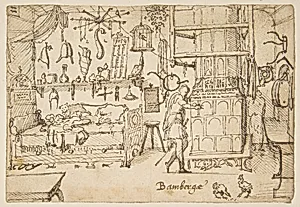
Study sheets with sketches of interiors, animals, sculpture, figures, notes
16th century
Medium
Pen and brown ink
Dimensions
each sheet: 4 5/16 x 6 1/8 in. (11 x 15.5 cm)
Classification
Drawings
Department
Drawings and Prints
Museum
Metropolitan Museum of Art, New York, NY
Credit
Purchase, C. G. Boerner Gift, 2008
Accession Number
2008.222
Rights
Public Domain
Tags
Art Historical Context
These intimate study sheets, created by an anonymous German artist in the 16th century, offer a fascinating glimpse into the Renaissance artist's daily practice. Rendered in pen and brown ink on small sheets measuring just 4 5/16 x 6 1/8 inches, the sketches capture a diverse array of subjects: detailed interiors with beds and furnishings, lively animals, classical sculptures, male figures in motion, and even handwritten notes. This portable format suggests they were jotted down from life or memory, serving as a personal sketchbook for an artist honing observational skills during Northern Europe's artistic awakening. Pen and brown ink was a favored medium in 16th-century Germany, prized for its precision and versatility—allowing fluid lines for architecture, textured shading for fur and drapery, and quick annotations for ideas. Such studies reflect the era's shift toward naturalism, influenced by Italian Renaissance ideals filtering north via prints and travel, as German artists like Albrecht Dürer emphasized direct study from nature and antiquities. Acquired by The Metropolitan Museum of Art in 2008 through the C. G. Boerner Gift, these sheets highlight the unsung labor behind grand paintings and sculptures. They remind us that even anonymous hands contributed to the era's cultural flowering, bridging everyday observation with enduring artistic innovation.