
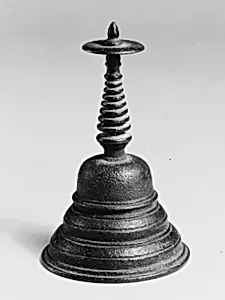
Stupa
Unknown Artist
ca. 9th century
Medium
Bronze
Dimensions
4 1/2 x 3 3/4 in. (11.5 x 9.5 cm)
Classification
Sculpture
Culture & Period
India · Pala period
Department
Asian Art
Museum
Metropolitan Museum of Art, New York, NY
Credit
Gift of Anita and Stanley Eisenberg, 1986
Accession Number
1986.497.8
Rights
Public Domain
Art Historical Context
This exquisite bronze stupa, crafted in India during the Pala period around the 9th century, stands as a miniature marvel of Buddhist devotion. Measuring just 4½ x 3¾ inches, it likely served as a votive object architectural model, evoking the grand hemispherical mounds that house sacred relics of the Buddha. The Pala dynasty (8th–12th centuries), ruling from eastern India and Bengal, fostered a golden age of Buddhist art, supporting monasteries like Nalanda and producing refined metalworks that blended spiritual symbolism with technical mastery. Cast in bronze—a medium prized for its durability and luminous patina—this sculpture exemplifies Pala artisans' lost-wax technique, allowing intricate details such as harmika finials and toranas (gateways) that symbolize the path to enlightenment. Stupas were central to Buddhist cosmology, representing the five elements and the cycle of rebirth, making this piece a portable emblem of faith amid a era of religious patronage before Hinduism's resurgence. Gifted to the Metropolitan Museum of Art by Anita and Stanley Eisenberg in 1986, this rare survivor invites us to ponder the piety of ancient worshippers, bridging the spiritual landscapes of medieval India with our modern gaze.