
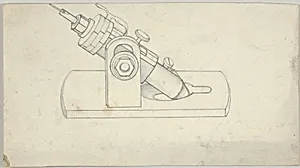
Stylus of a Machine Used for Engraving Bank notes
19th century
Medium
Graphite on thin cardboard
Dimensions
sheet: 3 11/16 x 6 7/16 in. (9.3 x 16.4 cm)
Classification
Drawings
Department
Drawings and Prints
Museum
Metropolitan Museum of Art, New York, NY
Credit
Gift of Joseph Veach Noble, 2002
Accession Number
2002.333.65
Rights
Public Domain
Tags
Art Historical Context
This delicate graphite drawing by Cyrus Durand captures the stylus of a specialized machine designed for engraving banknotes in the nineteenth century. Rendered on thin cardboard with precise, economical lines, the study highlights the mechanical tool’s fine point and structural details. Durand, an artist and inventor active during America’s expanding financial system, used such instruments to create intricate, hard-to-replicate patterns that protected currency from counterfeiters. The work reflects a pivotal moment when art and technology converged to safeguard economic trust. Machine engraving allowed for complex geometric designs impossible to achieve by hand, transforming banknote production into a blend of precision engineering and artistic skill. Though modest in scale—measuring just under four by six and a half inches—the drawing offers insight into the inventive spirit of the era, when draftsmen like Durand helped shape both visual culture and national security. Acquired by the Metropolitan Museum as a gift in 2002, this piece from the Department of Drawings and Prints reminds viewers how everyday tools of industry could become subjects worthy of artistic attention.