
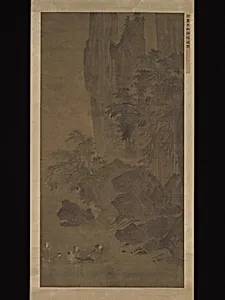
Su Dongbo's Visit to Chibi
Medium
Hanging scroll; on silk
Dimensions
70 3/4 x 37 in. (179.7 x 94 cm)
Classification
Paintings
Culture & Period
China · Ming (1368–1644) or Qing (1644–1911) dynasty
Department
Asian Art
Museum
Metropolitan Museum of Art, New York, NY
Credit
Gift of Ellis G. Seymour, 1926
Accession Number
26.114.5
Rights
Public Domain
Art Historical Context
Step into the poetic world of ancient China with *Su Dongbo's Visit Chibi*, a captivating hanging scroll painted on silk by an unidentified artist, possibly Xiao Zhao. Measuring an impressive 70¾ x 37 inches (179.7 x 94 cm), this work from the Ming (1368–1644) or Qing (1644–1911) dynasty vertically like a storybook, inviting viewers to savor its delicate brushwork and serene composition. Hanging scrolls like this were prized in literati culture, unrolled for contemplation during scholarly gatherings or festivals, blending art with personal reflection. The title evokes Su Dongbo—better known as Su Shi, the renowned Song dynasty poet, calligrapher, and statesman—who famously visited the Red Cliffs (Chibi), site of the pivotal Three Kingdoms battle in 208 CE. His nocturnal boat excursion there inspired the timeless poem *The Rearranged Cliffs* (Nian Nui Jiao: Chibi Huayong), capturing themes of time's passage, nature's grandeur, and human transience. This painting likely commemorates that moment, rendering misty riverscapes, rugged cliffs, and perhaps Su Shi's contemplative figure amid companions, embodying the wenrenhua (literati painting) tradition's emphasis on emotional resonance over literal depiction. Housed in the Metropolitan Museum of Art's Asian Art Department as a 1926 gift from Ellis G. Seymour, this scroll highlights silk's luminous texture, ideal for subtle ink washes and vivid mineral pigments. It offers a window into China's enduring reverence for history and poetry, reminding us how art immortalizes fleeting inspiration.