
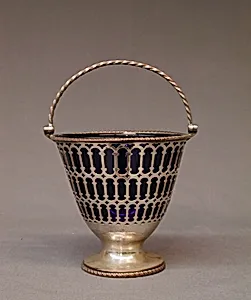
Sugar bowl
Unknown Artist
ca. 1775–85
Medium
Sheffield plate
Dimensions
6 3/8 × 4 3/4 in. (16.2 × 12.1 cm)
Classification
Metalwork-Silverplate
Culture
British, Sheffield
Department
European Sculpture and Decorative Arts
Museum
Metropolitan Museum of Art, New York, NY
Credit
Rogers Fund, 1910
Accession Number
10.16.16a, b
Rights
Public Domain
Art Historical Context
This elegant sugar bowl, crafted around 1775–85 in Sheffield, England, the ingenuity of British metalworking during the late Georgian era. Measuring a compact 6 3/8 × 4 3/4 inches, it was made using Sheffield plate—a revolutionary technique where sheets of copper were fused with silver to mimic the luster of solid silver at a fraction of the cost. Developed in Sheffield in the mid-18th, this method democratized luxury tableware, allowing middle-class households to enjoy refined domestic silver without the expense of hallmarked sterling. Sheffield plate objects like this sugar bowl were integral to the rising ritual of afternoon tea, fueled by Britain's colonial trade in sugar and tea from the East Indies and Caribbean. The bowl's simple yet graceful form reflects neoclassical tastes of the period, prioritizing clean lines and functionality over ornate embellishment. Produced by an unknown artisan in Sheffield's bustling workshops, it highlights the region's dominance in industrial-scale decorative arts. Acquired through the Rogers Fund in 1910 and now housed in the Metropolitan Museum of Art's European Sculpture and Decorative Arts department, this piece offers a tangible glimpse into 18th-century British life, where innovation met everyday elegance.