
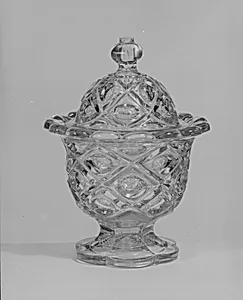
Sugar bowl
Unknown Artist
1850–70
Medium
Pressed glass, diamond thumbprint
Dimensions
H. 7 in. (17.8 cm); Diam. 5 3/8 in. (13.7 cm)
Classification
Sugar bowl
Culture
American
Department
The American Wing
Museum
Metropolitan Museum of Art, New York, NY
Credit
Gift of Mrs. Emily Winthrop Miles, 1946
Accession Number
46.140.24a, b
Rights
Public Domain
Art Historical Context
Nestled in the American Wing of the Metropolitan Museum Art, this elegant sugar bowl exemplifies mid-19th-century pressed glass craftsmanship. Dating from 1850–70, it stands 7 inches tall with a 5⅜-inch diameter, featuring the distinctive "diamond thumbprint"—a repeating motif of diamond-shaped facets that mimic the imprint of a thumb, adding tactile texture and visual sparkle. Donated in 1946 by Mrs. Emily Winthrop Miles, anonymous work highlights everyday luxury from America's Victorian era. Pressed glass emerged in the 1830s as a revolutionary technique, using metal molds to mass-produce intricate designs once reserved for expensive cut glass. This democratized ornate tableware, making it accessible to middle-class households during a time of rapid industrialization and westward expansion. The diamond thumbprint pattern, popular in New England factories, evoked the opulence of European imports while showcasing American ingenuity. As a functional yet decorative object, the sugar bowl reflects the cultural importance of refined domestic rituals in antebellum America—think tea parties and family gatherings sweetened with refined sugar, a status symbol post-Industrial Revolution. Though created by an unknown artisan, it captures the era's blend of utility and artistry, inviting us to appreciate the unsung beauty of historical home life.