
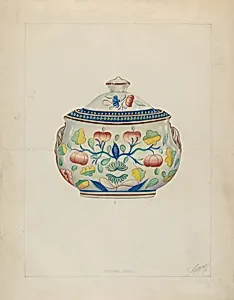
Sugar Bowl
c. 1936
Medium
watercolor, graphite, and colored pencil on paper w/ brown paper backing.
Dimensions
overall: 35.7 x 27.9 cm (14 1/16 x 11 in.)
Classification
Index of American Design
Department
CG-W
Museum
National Gallery of Art, Washington, D.C.
Credit
Index of American Design
Accession Number
1943.8.7217
Rights
Public Domain
Art Historical Context
This precise rendering of a sugar bowl, created around 1936 by Arthur Wegg, belongs to the Index of American Design, a Depression-era initiative that employed artists to document America’s decorative arts and folk traditions. Produced under the Federal Art Project, these works formed a visual archive of objects from colonial times through the nineteenth century, capturing everyday items that reflected national craftsmanship and domestic life. Wegg used watercolor, graphite, and colored pencil to achieve the project’s hallmark accuracy, rendering textures, reflections, and forms with almost photographic fidelity. The brown paper backing, typical of Index sheets, protected the delicate surface while presenting the image as a study rather than a finished painting. Such techniques transformed a utilitarian vessel into a record of design history. Sugar bowls themselves were once central to American hospitality, appearing in silver, porcelain, or glass on dining tables across social classes. By isolating this object, Wegg’s drawing invites viewers to appreciate both the original artisan’s skill and the New Deal artists’ role in preserving cultural memory. Today it stands as a quiet testament to how ordinary household objects embody the ingenuity and aesthetic values of earlier generations.