
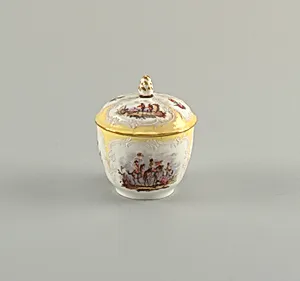
Sugar Bowl with Battle Scenes (Bataillen-Malerei)
Classification
ceramics
Department
Smithsonian Collection
Museum
Smithsonian American Art Museum
Credit
Bequest of Georgiana L. McClellan
Accession Number
1953-17-48-a,b
Rights
Public Domain
About this artwork
Research in Progress
Art Historical Context
This elegant sugar bowl, produced by the renowned Royal Porcelain Manufactory Berlin (KPM,. 1763), late 19th-century German artistry from the period 1870–1900. Established under royal patronage, KPM was for its technically superior porcelain, blending functionality with opulent decoration. Shaped as a refined tableware piece, it reflects the era's fascination with historicism, where everyday objects became canvases for grand narratives. The bowl's defining feature is its *Bataillen-Malerei*—finely painted battle scenes that evoke the military triumphs and national pride of the newly unified German Empire. These intricate overglaze enamel decorations, a hallmark of KPM's mastery, capture dynamic compositions on the smooth white porcelain body, transforming a humble sugar bowl into a miniature historical tableau. Such motifs were popular amid the Franco-Prussian War's aftermath, symbolizing Prussian valor and imperial ambition. Now part of the Smithsonian American Art Museum's collection through the bequest of Georgiana L. McClellan, this piece invites reflection on how ceramics bridged domestic life and cultural memory. Though research continues, it stands as a testament to Berlin's porcelain legacy, where artistry met patriotism in delicate form.