
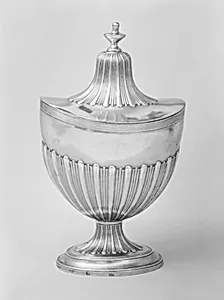
Sugar bowl with cover
last quarter 18th century
Medium
Silver
Dimensions
Overall: 8 1/2 × 5 in. (21.6 × 12.7 cm)
Classification
Metalwork-Silver
Culture
Portuguese, Oporto
Department
European Sculpture and Decorative Arts
Museum
Metropolitan Museum of Art, New York, NY
Credit
Rogers Fund, 1912
Accession Number
12.124.23a, b
Rights
Public Domain
Art Historical Context
This elegant sugar bowl with cover, crafted the silversmith M. H. P. in Oporto, Portugal, during the last quarter of the 18th century exemplifies the refined metalwork traditions of late Enlightenment-era Europe. Measuring 8½ × 5 inches, its substantial silver form was designed for serving refined sugar—a luxury commodity symbolizing wealth amid Portugal's booming trade with its Brazilian colonies. Oporto, a vibrant port city, was a hub for skilled silversmiths who produced high-quality domestic wares for affluent households. The piece's silver medium highlights masterful chasing and engraving techniques typical of Portuguese decorative arts, blending Rococo exuberance with emerging Neoclassical restraint. Such bowls were essential to the elaborate tea and coffee rituals of the aristocracy, showcasing the artisan's precision in balancing functionality with ornamentation. Hallmarks from M. H. P. affirm its authenticity as a product of Oporto's guild-regulated workshops. Acquired through the Rogers Fund in 1912 and now housed in the Metropolitan Museum of Art's European Sculpture and Decorative Arts department, this sugar bowl offers a tangible glimpse into 18th-century Portuguese culture, where colonial riches fueled artistic excellence in everyday luxury.