
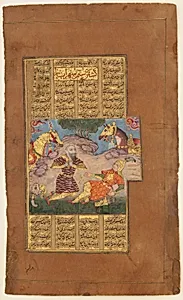
"Suhrab Slain by Rustam", Folio from a Shahnama (Book of Kings) of Firdausi
ca. 1610
Medium
Ink, opaque watercolor, and gold on paper
Dimensions
Page: H. 8 in. (20.3 cm) W. 4 13/16 in. (12.2 cm) Painting: H. 2 5/8 in. (6.7 cm) W. 3 1/8 in. (8 cm)
Classification
Codices
Department
Islamic Art
Museum
Metropolitan Museum of Art, New York, NY
Credit
Gift of Jeffrey Kossak, The Kronos Collections, 1985
Accession Number
1985.404.1
Rights
Public Domain
Tags
Art Historical Context
This poignant folio from a *Shahnama* (Book of Kings), the epic by Abu'l Qasim Firda completed around 1010 CE, captures the tragic climax of the tale "Suhrab Slain byam." Dating to circa 1610 during the Safavid dynasty in Persia (modern Iran), it illustrates the heroic warrior Rustam unknowingly striking down his own son, Suhrab, in a dramatic moment of fate and unrecognized kinship. As part of an illuminated codex in the Islamic Art tradition, this page embodies the Persian miniature style, where intricate storytelling unfolds in compact scenes filled with dynamic figures, horses, and emotional intensity. Crafted with ink for precise outlines, vibrant opaque watercolors for rich hues, and gold accents for luminous highlights, the artwork exemplifies Safavid mastery of manuscript illumination. The small painting (just 2⅝ × 3⅛ inches) nestles within a larger folio page (8 × 4⅞ inches), designed for intimate contemplation in royal libraries, blending poetry and visual narrative seamlessly. Culturally, the *Shahnama* served as Iran's national epic, preserving pre-Islamic myths and moral lessons on heroism, destiny, and tragedy. Gifted to the Metropolitan Museum of Art in 1985, this folio invites visitors to ponder timeless themes through the lens of Persian artistry, where every brushstroke echoes centuries of oral and written tradition.
About the Artist
Abu'l Qasim Firdausi · 935–1020
Abu'l Qasim Firdausi, born around 940 in the village of Paj near Tus in Khorasan (modern-day Iran), emerged from a family of landed gentry known as dehqans, who preserved ancient Iranian oral traditions amid the cultural renaissance of the Samanid Empire. Little is documented about his early life or formal training, though he likely received a basic education including Arabic literacy, immersing h...