
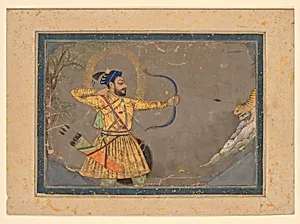
Sultan ‘Ali ‘Adil Shah II Slays a Tiger
ca. 1660
Medium
Ink, opaque watercolor, gold, and probably lapis-lazuli pigment on paper
Dimensions
Frame: 17 3/8 × 20 11/16 × 7/8 in. (44.1 × 52.5 × 2.2 cm) Image: 8 7/16 × 12 3/8 in. (21.5 × 31.5 cm)
Classification
Codices
Department
Islamic Art
Museum
Metropolitan Museum of Art, New York, NY
Credit
Howard Hodgkin Collection, Purchase, Florence and Herbert Irving Acquisitions, Harris Brisbane Dick, and 2020 Benefit Funds; Howard S. and Nancy Marks, Lila Acheson Wallace, and Friends of Islamic Art Gifts; Louis V. Bell, Harris Brisbane Dick, Fletcher, and Rogers Funds and Joseph Pulitzer Bequest; and funds from various donors, 2022
Accession Number
2022.199
Rights
Public Domain
Tags
Art Historical Context
In the vibrant tradition of Deccani miniature painting, *Sultan ‘Ali ‘il Shah II Slays Tiger* (ca. 1660), attributed to the Bombay Painter, a dramatic moment of royal heroism. This folio from what may be a codex depicts the sultan of the Bijapur Sultanate—ruler from 1558 1580—dispatching a ferocious tiger with bow and arrow. Such shikar (hunting) were emblematic of a sovereign's prowess, blending Islamic patronage with Indian artistic flair during the 17th century in the Deccan region of India. Rendered in ink, opaque watercolor, gold, and likely costly lapis-lazuli pigment on paper, the work exemplifies the opulence of Islamic court art. The vivid blues from lapis, a prized import from Afghanistan, and shimmering gold accents heighten the scene's intensity, while the compact composition (8 7/16 × 12 3/8 in.) draws viewers into the action. Deccani painters like the Bombay Painter favored bold colors and dynamic poses, influenced by Persian miniatures yet infused with local vitality. Housed in the Metropolitan Museum of Art's Islamic Art department, this piece from the Howard Hodgkin Collection highlights the Adil Shahi dynasty's cultural legacy. It invites us to marvel at how art immortalized rulers' bravery, bridging history and storytelling across centuries.