
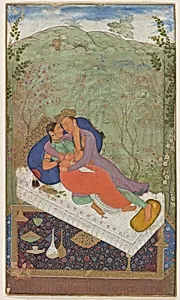
Sultan Murad and a Consort
Classification
Painting
Department
Smithsonian Collection
Museum
Smithsonian American Art Museum
Credit
Purchase — Charles Lang Freer Endowment
Accession Number
F1929.80
Rights
Public Domain
Tags
About this artwork
Mughal Court
Art Historical Context
This exquisite painting, attributed to the Mughal artist Manohar and created around 1597, captures an intimate moment between Sultan Murad—son of Emperor Akbar—and a consort. Produced during the height of the Mughal dynasty in India, it reflects the refined court culture of Akbar’s reign (1556–1605), when royal patronage elevated painting as a means of celebrating both power and personal life. The work belongs to the rich tradition of South Asian court art, where scenes of lovers often blended Persian influences with Indian sensibilities to portray harmony, affection, and imperial elegance. Manohar, active from the 1580s into the early 1600s, was celebrated for his sensitive portraits and ability to convey subtle emotion through delicate line work and harmonious compositions. Though the exact medium remains unrecorded, such Mughal paintings typically combined fine brushwork with vibrant pigments on prepared paper, allowing for intricate details in clothing, jewelry, and architectural settings that reveal the opulence of court life. As part of the Smithsonian’s collection of South Asian and Himalayan art, this piece offers visitors a window into the multicultural world of the Mughal Empire, where art served both as historical record and poetic expression of human connection.