
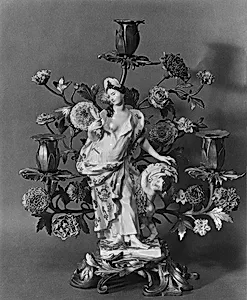
Summer
modeled 1745
Medium
Hard-paste porcelain, gilt-bronze mounts
Dimensions
Height: 15 1/2 in. (39.4 cm)
Classification
Ceramics-Porcelain
Culture
German, Meissen with French mounts
Department
European Sculpture and Decorative Arts
Museum
Metropolitan Museum of Art, New York, NY
Credit
Gift of Ann Payne Blumenthal, 1943
Accession Number
43.163.11a, b
Rights
Public Domain
Tags
Art Historical Context
**Summer** (modeled 1745) by Johann Friedrich Eberlein for the Meissen Manuf exemplifies the pinnacle of 18th-century European porcelain. Meissen, the first European factory to produce true hardaste porcelain—a durable, translucent material rivaling Chinese imports—thrived under royal patronage in Saxony, Germany. Eberlein, a master modeler, crafted this vibrant figurine during the Rococo era, a time of playful elegance and naturalistic motifs. Standing 15½ inches tall, it features delicate porcelain adorned with later French gilt-bronze mounts, blending German precision with opulent French luxury. The sculpture likely personifies the season through joyful figures of boys and women amid blooming flowers, capturing summer's abundance in porcelain's fine detail. Tags evoke frolicking children and graceful maidens surrounded by floral abundance, hallmarks of Meissen's whimsical figurative groups. These works adorned aristocratic tables and cabinets, symbolizing prosperity and the harmony of nature. A gift to the Metropolitan Museum of Art in 1943 from Ann Payne Blumenthal, **Summer** highlights Meissen's cultural dominance in decorative arts. Its survival showcases the era's technical innovation—polychrome enameling and gilding fired at high temperatures—making it a treasured example of how porcelain bridged utility and high art for Europe's elite.
About the Artist
Johann Friedrich Eberlein|Meissen Manufactory (German|German) · 1710 |1695 –9999 |1749
German, 1710–present|German, 1695–1749