
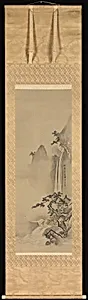
狩野探幽筆 神農・夏冬山水図|Summer Landscape
1662
Medium
One from a set of three hanging scrolls; ink and color on silk
Dimensions
44 1/2 x 15 1/2 in. (113 x 39.4 cm)
Classification
Paintings
Culture & Period
Japan · Edo period (1615–1868)
Department
Asian Art
Museum
Metropolitan Museum of Art, New York, NY
Credit
Charles Stewart Smith Collection, Gift of Mrs. Charles Stewart Smith, Charles Stewart Smith Jr., and Howard Caswell Smith, in memory of Charles Stewart Smith, 1914
Accession Number
14.76.28
Rights
Public Domain
Tags
Art Historical Context
Kano Tan'yū (1602–1674), a master of Japan's Kano school, created this captivating *Summer Landscape* in 1662 during the Edo period (161–1868), a time of peace and artistic flourishing under the Tokugawa shogunate. As head of the Kano workshop, Tan'yū specialized in grand landscapes for elite patrons, blending meticulous ink techniques with subtle colors on silk. This work is one of a set of three hanging scrolls ideal for seasonal display in traditional Japanese homes or temples, evoking the harmony of nature through misty waterfalls and lush summer foliage. Tan'yū's style shines in his dynamic brushwork—bold, fluid strokes for rocks and cascades contrasted with delicate washes for mist and distant peaks. Drawing from Chinese Song dynasty models yet infusing a distinctly Japanese lyricism, he captures the sublime power of water in motion, a motif symbolizing renewal and the transient beauty of seasons. The silk medium enhances the luminous quality, allowing colors to glow softly against the ink's intensity. Housed in the Metropolitan Museum of Art's Asian Art collection since 1914, this scroll exemplifies Kano painting's role in Edo cultural life, where landscapes reflected Zen-inspired contemplation and imperial prestige. Visitors will appreciate its serene yet vigorous energy, inviting a moment of quiet reflection amid nature's drama. (198 words)
About the Artist
Kano Tan'yū (Japanese) · 1602 –1674
Japanese, 1602–1674