
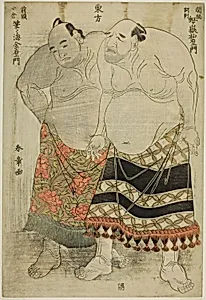
Sumo Wrestlers of the Eastern Group: (right) Nijigadake Somaemon of Sekiwake Rank from Awa Province, and (left) Fudenoumi Kin'emon of Maegashira Rank from Kokura
c. 1782/83
Medium
Color woodblock print; oban
Dimensions
38.2 × 26 cm (15 1/16 × 10 1/4 in.)
Classification
woodblock print
Department
Arts of Asia
Museum
Art Institute of Chicago
Accession Number
64444
Rights
Public Domain
Art Historical Context
This vibrant woodblock print by Katsukawa Shunshō, a leading figure of the ukiyo-e ("pictures of the floating world") tradition, captures two formidable sumo wrestlers from the Group during a tournament around 1782–83. On the right stands Nijigadake Somaemon, a sekiwake (second-highest rank) from Awa Province, facing Fudenoumi Kin'emon, a maegashira (mid-tier rank) from Kokura. Created in the popular oban format—measuring about 38 × 26 cm—these color prints were affordable and widely circulated in Edo-period Japan (1603–1868), turning wrestlers into celebrity icons akin to modern athletes. Sumo, Japan's national sport with roots in Shinto rituals, exploded in popularity during the 18th century, with grand tournaments drawing massive crowds. Shunshō, renowned for his dynamic yakusha-e (actor portraits), applied similar expressive techniques here: bold lines, rich colors from layered woodblocks, and dramatic poses that convey the wrestlers' power and rivalry. Printed pigments like Prussian blue and vermilion added vivid realism, making these sheets prized collectibles. Housed in the Art Institute of Chicago's Arts of Asia collection, this work highlights ukiyo-e's role in democratizing art and preserving sumo's cultural spectacle, offering a window into the thrill of Edo's entertainment world.