
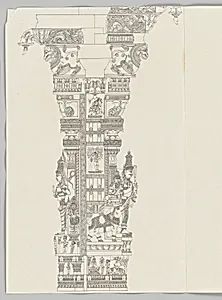
Sundareshvara feeding sugarcane to the elephant
ca. 1800
Medium
Ink and wash on J. Whatman paper watermarked 1798
Dimensions
Sheet (folded): 16 1/8 × 10 1/16 in. (41 × 25.5 cm) Sheet: 16 1/8 × 20 1/8 in. (41 × 51.1 cm)
Classification
Paintings
Culture
India, Madurai, Tamil Nadu
Department
Asian Art
Museum
Metropolitan Museum of Art, New York, NY
Credit
Purchase, Friends of Asian Art Gifts, 2021
Accession Number
2021.328
Rights
Public Domain
Art Historical Context
This delicate ink and wash painting, titled *Sundareshvara Feedingarcane to the Elephant captures a tender moment from South Indian Hindu devotion, created around 1800 in Madurai, Tamil. Sundareshvara, a of the god Shiva as the consort of the goddess Meenakshi, is depicted offering sugarcane to an elephant—a motif evoking temple rituals and divine benevolence at Madurai's famed Meenakshi Temple complex. Produced by an unidentified artist, the work reflects the vibrant Shaivite traditions of the region, where such scenes blended mythology with everyday piety. Executed on J. Whatman paper watermarked 1798, the medium highlights a fascinating cultural exchange during British colonial rule. Whatman paper, prized English wove paper known for its smoothness and durability, was imported to India and favored by local artists for intricate ink washes and fine lines. This choice allowed for subtle tonal gradations and fluid brushwork, bridging traditional Indian techniques with European materials—a hallmark of the Company School style popular among East India Company patrons. Housed in the Metropolitan Museum of Art's Asian Art Department since 2021, this folded-sheet painting (unfolded to 16⅛ × 20⅛ in.) offers a window into 19th-century Tamil artistic life, preserving a slice of devotional iconography amid global trade networks. Visitors will appreciate its intimate scale and evocative storytelling, inviting reflection on faith, nature, and cross-cultural artistry.
About the Artist
Unidentified ( ) · –