
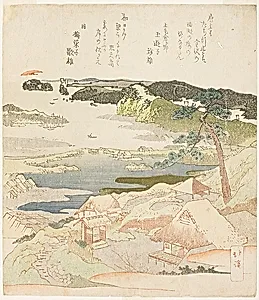
Sunrise on New Year's Day at Kanazawa
early 19th century
Medium
Color woodblock print; surimono
Dimensions
21.2 × 18.5 cm (8 3/8 × 7 5/16 in.)
Classification
woodblock print
Department
Arts of Asia
Museum
Art Institute of Chicago
Accession Number
81139
Rights
Public Domain
Art Historical Context
**Sunrise on New Year's Day at Kanazawa** Totoya Hokkei captures the serene beauty of a fresh dawn in early 19th-century Japan Created during the Edo period, this intimate color woodblock print exemplifies Hokkei's mastery in the ukiyo-e tradition, where he followed in the footsteps of his teacher, Katsushika Hokusai. Hokkei specialized in surimono—luxurious, privately commissioned prints often produced for New Year's celebrations, featuring exquisite craftsmanship like subtle embossing, metallic pigments, and mica dusting to evoke a sense of festivity and renewal. Measuring just 21.2 × 18.5 cm, the compact format was ideal for personal exchange as seasonal greetings among Japan's cultured elite. The scene likely depicts Kanazawa's historic landscape—famed for its samurai heritage and stunning Kenrokuen Garden—at the pivotal moment of sunrise on Oshogatsu (New Year's Day), symbolizing hope, prosperity, and the fleeting nature of time central to Japanese aesthetics. Surimono like this often included kyoka poems, blending art with literature for a multisensory delight. Hokkei's precise lines and vibrant colors highlight the woodblock technique's ingenuity, where multiple carved blocks were inked and overlaid for depth. Housed in the Art Institute of Chicago's Arts of Asia collection, this print offers visitors a window into Edo Japan's refined print culture, where everyday wonders became poetic treasures.
About the Artist
Totoya Hokkei · 1780–1850
Totoya Hokkei (魚屋 北渓, 1780–1850), born Iwakubo Tatsuyuki in Edo (modern Tokyo), began his life as a humble fishmonger in the Yotsuya Samegahashi district, a trade reflected in his art name "Totoya," meaning fish shop. He transitioned to art through rigorous training, first studying under Kanō Yōsen'in Korenobu, head of the Kobikichō branch of the prestigious Kanō school, where he honed landscape p...