
Sunset near Arbonne
Théodore Rousseau, ca. 1860–65
About this artwork
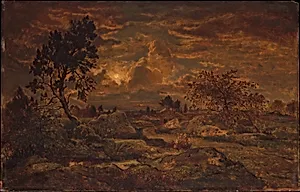
Théodore Rousseau's *Sunset near Arbonne* (ca. 1860–65) captures the dramatic beauty of a fading day in the French countryside near Arbonne, a coastal village in the Basque region. As a leading figure of the Barbizon School—a mid-19th-century movement of realist landscape painters—Rousseau rejected the polished, idealized vistas of Romanticism in favor of direct observation from nature. Working en plein air or from meticulous studies, he emphasized the raw power of light, atmosphere, and earthy textures, influencing later Impressionists like Monet. Painted in oil on wood—a durable panel medium favored for its smooth surface and portability—this 25¼ × 39-inch work showcases Rousseau's mastery of luminous effects. The sunset's warm glow bathes the rolling hills and distant sea in golden hues, contrasting with deepening shadows to evoke a profound sense of transience. Such evening landscapes highlight his fascination with nature's moods, blending poetic reverence with scientific precision in color and form. Now in the Metropolitan Museum of Art's European Paintings collection (Bequest of Collis P. Huntington, 1900), this piece invites visitors to pause and reflect on the timeless allure of a Barbizon twilight, where heaven meets earth in quiet splendor.