
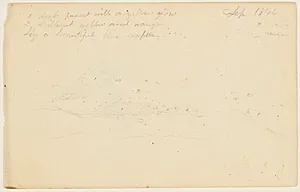
Sunset over the Catskills, Catskill, New York
September 1844 and June 1845
Medium
landscapes
Classification
landscapes
Department
Smithsonian Collection
Museum
Smithsonian American Art Museum
Credit
Gift of Louis P. Church
Accession Number
1917-4-1431
Rights
Public Domain
About this artwork
Research in Progress
Art Historical Context
Frederic Edwin Church's *Sunset over the Catskills, Catskill, New York* (1844–1845) captures the dramatic beauty of New York's Catskill Mountains at dusk, a subject central to early American landscape painting. Painted when Church was just 18–19 years old, this work marks the beginning of his illustrious career. As a protégé of Thomas Cole, the founder of the Hudson River School—the first major native art movement in the United States—Church depicted the American wilderness with romantic reverence, emphasizing nature's grandeur and spiritual power. Rendered during separate sketching trips in September 1844 and June 1845, the painting reflects Church's meticulous on-site observation, a hallmark of Hudson River School techniques. Sunsets were a favored motif for these artists, symbolizing divine light piercing the temporal world and evoking the sublime—a concept blending awe and humility before untamed landscapes. The Catskills, immortalized by writers like Washington Irving, held cultural importance as emblems of America's pastoral identity amid rapid industrialization. Now in the Smithsonian American Art Museum's collection, gifted by Louis P. Church (likely a family member), this early masterpiece offers a window into Church's evolution from student to visionary painter whose works later inspired national pride and conservation efforts. Though research continues, it stands as a luminous testament to 19th-century America's artistic awakening.