
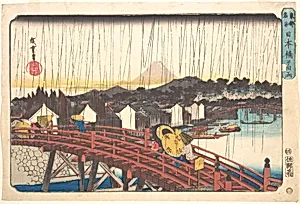
東都名所 日本橋の白雨|Sunshower at Nihonbashi
1833–34
Medium
Woodblock print; ink and color on paper
Dimensions
10 1/8 x 15 in. (25.7 x 38.1 cm)
Classification
Prints
Culture & Period
Japan · Edo period (1615–1868)
Department
Asian Art
Museum
Metropolitan Museum of Art, New York, NY
Credit
Rogers Fund, 1918
Accession Number
JP526
Rights
Public Domain
Tags
Art Historical Context
Utagawa Hiroshige *Sunshower at Nihbashi* (1833–34) captures a fleeting moment in Edo-period Japan, from his early series *Famous Places the Eastern Capital* (ōto meisho). Nihonbashi, a wooden bridge spanning the city's vital waterway, was the heart of commerce and travel in Edo (modern Tokyo). This woodblock print, just 10⅛ × 15 inches, exemplifies ukiyo-e—the "pictures of the floating world"—a genre celebrating ephemeral beauty amid urban life during the Edo period (1615–1868). Hiroshige masterfully renders a sudden summer downpour, with pedestrians huddled under umbrellas, boats dotting the river, and houses lining the banks under dramatic gray skies. Distant mountains add depth, while his innovative use of Prussian blue and subtle gradations in ink and color on paper evoke the rain's cool intensity and transience. Woodblock printing, a collaborative craft involving skilled carvers and printers, allowed vibrant, affordable multiples that democratized art for everyday viewers. This Met Museum treasure highlights Hiroshige's influence on Impressionists like Monet, blending realism with poetic mood. It invites us to savor Japan's rainy seasons, where even a shower reveals the rhythm of city life.
About the Artist
Utagawa Hiroshige · 1826–1869
Utagawa Hiroshige (1797–1858), born Andō Tokutarō, was the last great master of Japanese ukiyo-e woodblock printmaking and one of the most influential landscape artists in history. Born in Edo (modern Tokyo) into a low-ranking samurai family serving as fire wardens, Hiroshige transformed landscape printmaking into a poetic meditation on nature, weather, and everyday life. His revolutionary approac...