
Supplement to "L'Omnibus de Corinthe"
1897
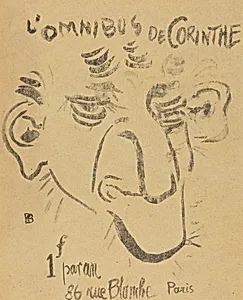
Medium
lithograph in black
Dimensions
overall: 37.9 x 27.8 cm (14 15/16 x 10 15/16 in.)
Classification
Department
CG-E
Museum
National Gallery of Art, Washington, D.C.
Credit
Virginia and Ira Jackson Collection
Accession Number
2000.180.89
Rights
Public Domain
Art Historical Context
Pierre Bonnard's *Supplement to "L'Omnibus de Corinthe"*1897) is a striking black lithograph that captures the artist's early mastery of printmaking during a vibrant period in French art. Created when Bonnard was just , this work belongs to his involvement with the Nabi group—a circle of Post-Impressionist painters who blended symbolism, decorative patterns, and bold graphics inspired by Japanese prints and Paul Gauguin. At 37.9 x 27.8 cm, its intimate scale suits the medium's affordability and reproducibility, making art accessible beyond elite canvases. As a supplement to the larger *L'Omnibus de Corinthe* project—likely tied to Bonnard's experimental posters and illustrations for Parisian theaters and publications—this lithograph highlights his fluid line work and tonal subtlety in monochrome. Lithography allowed Bonnard to draw directly on stone, preserving spontaneity akin to his later intimate domestic scenes. Produced amid the poster boom of the 1890s, alongside peers like Toulouse-Lautrec, it reflects fin-de-siècle Paris's cultural energy, where street art democratized visual culture. Housed in the National Gallery of Art's Virginia and Ira Jackson Collection (Department CG-E), this print offers visitors a window into Bonnard's evolution from graphic innovator to luminous colorist, showcasing the technical precision that underpinned his lifelong pursuit of light and everyday beauty.
About the Artist
Pierre Bonnard · 1867–1947
Pierre Bonnard (1867–1947) was a French painter and printmaker who became a leading figure in the Post-Impressionist movement and a founding member of Les Nabis. Born on October 3, 1867, in Fontenay-aux-Roses, France, Bonnard initially studied law at his father's insistence, graduating and briefly practicing as a barrister in 1888. However, his true passion lay in art, and he had simultaneously at...