
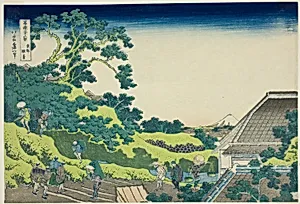
Surugadai in Edo (Toto surugadai), from the series "Thirty-six Views of Mount Fuji (Fugaku sanjurokkei)"
c. 1830/33
Medium
Color woodblock print; oban
Dimensions
25.9 × 37.5 cm (10 3/16 × 14 3/4 in.)
Classification
woodblock print
Department
Arts of Asia
Museum
Art Institute of Chicago
Accession Number
24751
Rights
Public Domain
Art Historical Context
Step into the vibrant world of 19th-century Japan with Katsushika Hokusai's *Surugadai in Edo (Tōto surugadai)*, a stunning color woodblock print from his series *Thirty-six Views Mount Fuji (Fugaku sanjurokkei)*, created around 1830–33. Hokusai, a master of the ukiyo-e ("pictures of the floating world") style, captures Mount Fuji rising majestically behind the rooftops of Edo (modern-day Tokyo) as seen from Surugadai hill. This oban-sized print (25.9 × 37.5 cm) brings the sacred peak into everyday urban life, blending natural grandeur with bustling cityscapes. Printed during Japan's Edo period, when woodblock prints democratized art for the masses, this work exemplifies Hokusai's innovative use of multiple woodblocks to layer vivid colors—known as *nishiki-e* or "brocade pictures." The series, which actually includes 46 views, revolutionized landscape art by emphasizing bold compositions, dramatic perspectives, and Fuji's symbolic role as a spiritual and national icon. Hokusai's genius influenced Western artists like Monet and Van Gogh, bridging Eastern and Western aesthetics. Gaze upon it at the Art Institute of Chicago's Arts of Asia department, and feel the timeless allure of a mountain that inspired generations.
About the Artist
Katsushika Hokusai · 1760–1849
Katsushika Hokusai (1760-1849) stands as one of history's most influential artists, a Japanese master who revolutionized the ukiyo-e woodblock print tradition and profoundly shaped Western art. Born in the Katsushika district of Edo (modern-day Tokyo) to an artisan family, Hokusai lived through nearly nine decades of extraordinary creative evolution, adopting over thirty different artistic names t...