
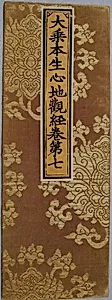
明 織錦經面|Sutra cover
Unknown Artist
16th century
Medium
Plain-weave silk with supplementary weft patterning
Dimensions
Overall: 13 5/16 x 4 3/4 x 1/8 in. (33.8 x 12.1 x 0.3 cm)
Classification
Textiles-Woven
Culture & Period
China · Ming dynasty (1368–1644)
Department
Asian Art
Museum
Metropolitan Museum of Art, New York, NY
Credit
Purchase, Friends of Asian Art Gifts, in honor of James C. Y. Watt, 2011
Accession Number
2011.221.8
Rights
Public Domain
Tags
Art Historical Context
This exquisite sutra cover, crafted in 16th-century Ming dynasty China, served as a protective wrapper for sacred Buddhist sutras—scriptures central to spiritual practice. Measuring a compact 13 5/16 x 4 3/4 inches, it exemplifies the refined textile arts of the era, when silk weaving reached new heights of sophistication under imperial patronage. Acquired by the Metropolitan Museum of Art in 2011, it honors curator James C. Y. Watt and reflects the Ming period's (1368–1644) blend of piety and artistry. Woven from plain-weave silk with supplementary weft patterning—a technique that interlaces colorful extra wefts to create intricate designs without additional warps—the cover features delicate floral motifs. This method allowed weavers to produce vibrant, brocade-like effects on a fine silk ground, showcasing technical mastery and the luxurious sheen of Chinese silk, prized worldwide via the Silk Road. In Ming Buddhist culture, such covers were not mere utilities but devotional objects, often gifted to temples. Adorned with auspicious flowers symbolizing purity and enlightenment, this piece highlights textiles' role in bridging the sacred and the sensual, inviting visitors to appreciate the weavers' anonymous genius.