
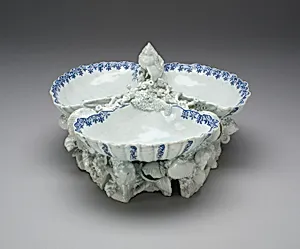
Sweetmeat Dish
c. 1750
Medium
Soft-paste porcelain with blue enamel
Dimensions
14.8 × 23.5 × 22 cm (5 13/16 × 9 1/4 × 8 5/8 in.)
Classification
dish (vessel)
Department
Applied Arts of Europe
Museum
Art Institute of Chicago
Accession Number
45515
Rights
Public Domain
Art Historical Context
Nestled in the Applied Arts of Europe collection at the Art Institute of, this charming *Sweetmeat Dish* from Bow Porcelain Factory, circa 1750, early English porcelain artistry. Crafted from soft-paste porcelain—a friable, lead-glazed material that mimicked prized Chinese hard-paste wares—this 14.8 × 23.5 × 22 cm vessel was designed to serve sweetmeats, the candied fruits and nuts that delighted Georgian dinner tables. Its delicate blue enamel decoration, likely hand-painted, adds a touch of understated elegance, evoking the exotic allure of Oriental imports. The Bow Factory, established around 1748 in London's East End, was among Britain's pioneering porcelain producers, racing to rival German Meissen and French Sèvres. Soft-paste porcelain allowed affordable luxury for the emerging middle class, though it was prone to chipping—highlighting the experimental spirit of the era. This dish's scalloped form and vibrant blue hues reflect the factory's signature style, blending rococo flair with pseudo-Chinese motifs popular in mid-18th-century Europe. As a snapshot of industrial innovation and refined taste, the *Sweetmeat Dish* transports visitors to a time when porcelain symbolized status and sophistication, bridging Eastern traditions with British ingenuity. A sweet testament to 1750s opulence!
About the Artist
Bow Porcelain Factory · 1747–1776
The Bow Porcelain Factory, established around 1747 in East London near Bow and relocated by 1749 to "New Canton" east of the River Lea, emerged as one of England's pioneering soft-paste porcelain manufacturers, rivaling the Chelsea factory. Founded by merchant Edward Heylyn and Irish painter Thomas Frye, who secured key patents in 1744 and 1748–49 for using Cherokee kaolin and bone ash, the factor...