
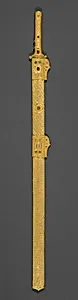
Sword and scabbard
Unknown Artist
ca. 7th century CE
Medium
Blade: iron; scabbard and hilt: gold over wood, garnets, glass-paste; guard: gilt-bronze
Dimensions
3 1/8 × 40 9/16 × 15/16 in. (8 × 103 × 2.4 cm)
Classification
Metalwork-Implements
Culture & Period
Sasanian · Sasanian
Department
Ancient Near Eastern Art
Museum
Metropolitan Museum of Art, New York, NY
Credit
Rogers Fund, 1965
Accession Number
65.28a, b
Rights
Public Domain
Tags
Art Historical Context
This exquisite sword and scabbard, dating to around the 7th century CE, hails from the Sasanian Empire, the last pre-Islamic Persian dynasty that flourished in the Ancient Near East. Measuring over 40 inches long, it exemplifies the opulent metalwork produced during this era, when Sasanian artisans crafted weapons not just for battle but as symbols of power and prestige for nobility and warriors. Acquired by The Metropolitan Museum of Art through the Rogers Fund in 1965, it now resides in the Department of Ancient Near Eastern Art. The blade is forged from sturdy iron, ideal for combat, while the hilt, scabbard, and guard dazzle with lavish decoration: gold overlay on a wood core, inlaid with vibrant garnets and glass-paste gems, plus a gilt-bronze guard. These techniques—gilding, cloisonné-style inlays, and gemstone settings—highlight Sasanian mastery in blending functionality with luxury, often drawing on motifs of animals or floral patterns to evoke imperial might and Zoroastrian symbolism. In Sasanian culture, such swords transcended mere tools; they embodied the warrior ethos central to Persian identity, bridging everyday warfare with royal splendor. This piece offers a glimpse into a sophisticated society on the cusp of transformation, just before the Arab conquest in 651 CE reshaped the region forever.