
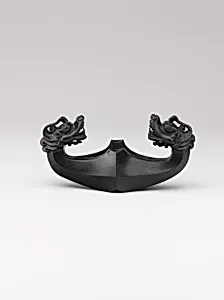
Sword Guard in the Form of Confronted Dragons
Unknown Artist
14th–early 15th century
Medium
Nephrite; carved
Dimensions
H. 2 in. (5.1 cm); W. 4 in. (10.2 cm); D. 1 1/4 in. (3.2 cm)
Classification
Jade
Culture & Period
Central Asia · Timurid period (1370–1507)
Department
Asian Art
Museum
Metropolitan Museum of Art, New York, NY
Credit
Gift of Heber R. Bishop, 1902
Accession Number
02.18.765
Rights
Public Domain
Tags
Art Historical Context
This exquisite sword guard, carved from nephrite jade during the Timurid period (1370–1507) in Central Asia, showcases the era's mastery of luxury craftsmanship. Measuring just 2 inches high by 4 inches wide, this small yet powerful object depicts two confronted dragons, their sinuous bodies intertwined in a dynamic, symmetrical pose. Nephrite, a tough and lustrous form of jade prized for its resilience and symbolic purity, was ideal for functional arms like this hand guard, which protected the wielder during combat while serving as a status symbol. The Timurid dynasty, founded by the conqueror Timur, flourished as a hub of artistic innovation blending Persian, Chinese, and Islamic influences. Dragons in Central Asian art often evoked power, guardianship, and cosmic forces, making them fitting motifs for weaponry. The intricate carving—likely achieved through painstaking abrasion and polishing techniques—highlights the period's technical virtuosity, transforming hard stone into fluid, life-like forms that balanced utility with opulence. A gift to the Metropolitan Museum of Art from Heber R. Bishop in 1902, this piece invites visitors to ponder the fusion of martial prowess and aesthetic refinement in Timurid culture, where even battle gear embodied imperial splendor.