
Sword Guard (Tsuba)
19th century
Medium
Copper-gold alloy (shakudō), silver, gold, copper
Dimensions
H. 2 11/16 in. (6.8 cm); W. 2 1/2 in. (6.4 cm); thickness 3/16 in. (0.5 cm); Wt. 4 oz. (113.4 g)
Classification
Sword Furniture-Tsuba
Culture
Japanese
Department
Arms and Armor
Museum
Metropolitan Museum of Art, New York, NY
Credit
Gift of Herman A. E. and Paul C. Jaehne, 1943
Accession Number
43.120.728
Rights
Public Domain
Tags
Art Historical Context
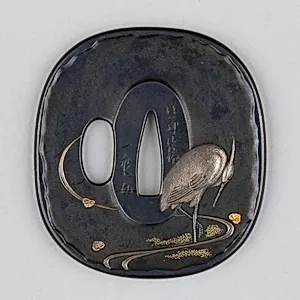
This exquisite sword guard, or *tsuba*, crafted by the master metalworker Gotō Ichij in 19th-century Japan, exemplifies the pinnacle of Edo-period sword furniture artistry. Measuring just 2⅝ by 2½ inches, this functional yet ornamental piece served as a hand guard on a samurai katana or wakizashi, blending protection with aesthetic refinement. Gotō Ichijō, from the illustrious Gotō school—metalworkers who served Japan's shoguns for generations—created it during a time when martial traditions were giving way to modernization, yet the demand for such luxurious fittings persisted among collectors. Fashioned primarily from shakudō (a copper-gold alloy that develops a rich black patina), the tsuba is inlaid with silver, gold, and copper, showcasing *zōgan* techniques where precious metals are hammered into precise designs. Bird motifs, a common theme evoking freedom, nature, and seasonal poetry in Japanese art, likely grace its surface, rendered with the Gotō family's signature subtlety and elegance. Weighing a substantial 4 ounces, its robust form highlights both craftsmanship and material mastery. Housed in the Metropolitan Museum of Art's Arms and Armor Department (gift of Herman A. E. and Paul C. Jaehne, 1943), this tsuba transports visitors to Japan's warrior past, where even weapons were vessels for poetic beauty and technical virtuosity.