
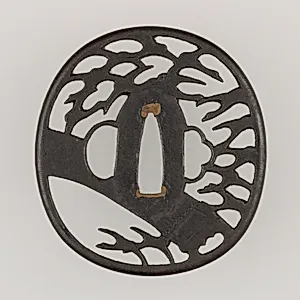
Sword Guard (Tsuba)
Unknown Artist
late 18th–early 19th century
Medium
Iron, copper
Dimensions
H. 3 1/8 in. (7.9 cm); W. 2 7/8 in. (7.3 cm); thickness 3/16 in. (0.5 cm); Wt. 3.1 oz. (87.9 g)
Classification
Sword Furniture-Tsuba
Culture
Japanese
Department
Arms and Armor
Museum
Metropolitan Museum of Art, New York, NY
Credit
Funds from various donors, 1946
Accession Number
46.122.164
Rights
Public Domain
Art Historical Context
This exquisite Sword Guard, or *tsuba*, hails from Japan during the late 18 to early 19th, a time when the Edo period's relative peace allowed samurai culture to flourish through refined craftsmanship. As part of a sword's hilt furniture, the *tsuba* served a practical purpose—protecting the hand from an opponent's blade—while doubling as a canvas for artistic expression. Crafted by an unknown master, this piece exemplifies the meticulous metalwork that elevated everyday warrior gear into wearable art. Forged from iron with copper elements, the guard measures a compact 3 1/8 by 2 7/8 inches, weighing just 3.1 ounces, making it both sturdy and balanced for combat. Japanese swordsmiths employed advanced techniques like piercing, hammering, and inlaying to create intricate openwork designs on *tsuba*, often drawing from nature, mythology, or daily life. The use of copper alongside iron added subtle color contrasts and corrosion resistance, highlighting the era's metallurgical expertise. In Japanese culture, *tsuba* were status symbols for samurai, traded, collected, and admired like jewelry. Acquired by the Metropolitan Museum of Art in 1946 through donor funds, this artifact offers a window into the blend of utility and beauty that defined feudal Japan's arms and armor tradition, reminding us how even tools of war could embody profound artistry.