
Sword Guard (Tsuba)
Unknown Artist
dated 1780
Medium
Iron, gold, copper
Dimensions
H. 2 1/2 in. (6.4 cm); W. 2 3/8 in. (6 cm); thickness 1/8 in. (0.3 cm); Wt. 2.2 oz. (62.4 g)
Classification
Sword Furniture-Tsuba
Culture
Japanese
Department
Arms and Armor
Museum
Metropolitan Museum of Art, New York, NY
Credit
The Howard Mansfield Collection, Gift of Howard Mansfield, 1936
Accession Number
36.120.138
Rights
Public Domain
Tags
Art Historical Context
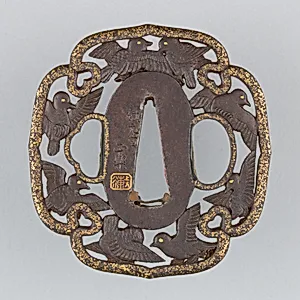
This exquisite Sword Guard, or *tsuba*, hails from Japan in 1780, during the period—a time of relative peace when samurai culture flourished alongside refined arts and craftsmanship. As a key piece of sword furniture, the tsuba served as both a protective handguard for katana or wakizashi blades and a canvas for artistic expression. Crafted by an unknown master, its compact form (2½ x 2⅜ inches) belies its intricate beauty, now housed in the Metropolitan Museum of Art's Arms and Armor Department as part of The Howard Mansfield Collection (gift of 1936). Forged from iron with inlays of shimmering gold and copper, the tsuba exemplifies *nunome-zogan* techniques, where precious metals are meticulously hammered into etched iron grounds for a luxurious contrast. The design likely features birds—a recurring motif in Japanese art symbolizing freedom, seasonal change, and harmony with nature—highlighting the era's appreciation for subtle symbolism over overt decoration. Beyond utility, such tsuba reflect Japan's warrior ethos blended with aesthetic philosophy, where even weapons embodied *wabi-sabi* elegance. Weighing just 2.2 ounces, this piece invites visitors to ponder the samurai's dual role as fighter and connoisseur.