
Sword Guard (Tsuba)
Unknown Artist
18th century
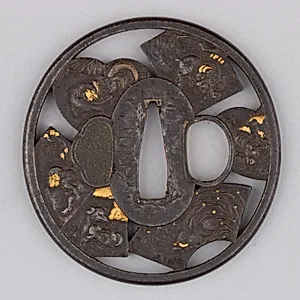
Medium
Iron, gold, silver, copper
Dimensions
Diam. 2 3/4 in. (7 cm); thickness 3/16 in. (0.5 cm); Wt. 4.2 oz. (119.1 g)
Classification
Sword Furniture-Tsuba
Culture
Japanese
Department
Arms and Armor
Museum
Metropolitan Museum of Art, New York, NY
Credit
Anonymous Gift, 1935
Accession Number
35.106
Rights
Public Domain
Tags
Art Historical Context
This exquisite 18th-century Japanesetsuba* (sword), crafted from iron inlaid with gold, silver and copper, served as a practical hand protector and canvas for artistic expression on samurai swords. Measuring just ¾ inches in diameter, compact form belies the openwork design featuring the of the Chinese zodiac—dragons, roosters dogs, monkeys, rabbits,, tigers, and oxensymbols deeply embedded in East Asian culture for representing the cyclical nature of time, personality traits, and cosmic harmony. During Japan's Edo period (16031868), a time of relative peace, *tsuba* evolved from functional armor into coveted art objects, showcasing the wearer's refined taste and status. Artisans employed sophisticated techniques like piercing (*sukashi*) to create delicate silhouettes and inlay (*zogan*) to highlight the vibrant animals with precious metals, blending utility with symbolism. The zodiac motif reflects influences from Chinese astrology, adapted into Japanese folklore, where these creatures embodied protection, strength, and good fortune. Housed in the Metropolitan Museum of Art's Arms and Armor Department as an anonymous gift from 1935, this *tsuba* invites visitors to appreciate the fusion of martial tradition and whimsical artistry, a testament to Japan's masterful metalworking heritage.