
Sword Guard (Tsuba)
Unknown Artist
ca. 1615–1868
Medium
Iron, copper-gold alloy (shakudō), gold, copper
Dimensions
H. 3 1/4 in. (8.3 cm); W. 3 in. (7.6 cm); thickness 3/16 in. (0.5 cm); Wt. 5.1 oz. (144.6 g)
Classification
Sword Furniture-Tsuba
Culture
Japanese
Department
Arms and Armor
Museum
Metropolitan Museum of Art, New York, NY
Credit
H. O. Havemeyer Collection, Bequest of Mrs. H. O. Havemeyer, 1929
Accession Number
29.100.1032
Rights
Public Domain
Tags
Art Historical Context
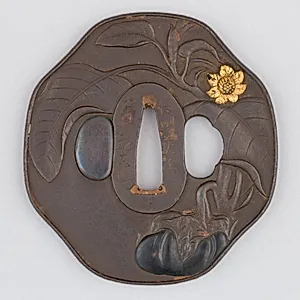
This exquisite *tsuba* (sword guard), dating from the Edo period (ca 1615–1868), served as a protective handguard on Japanese samurai swords, blending functionality with artistry. During this era of relative peace under the Tokugawa shogunate, sword fittings evolved into highly refined objects, showcasing the wearer's status and taste rather than battlefield utility. Crafted for katana or wakizashi blades, this iron-based guard measures a compact 3¼ by 3 inches, weighing 5.1 ounces—light yet sturdy for swift combat. The artwork's mixed metals highlight masterful Japanese techniques: a core of iron for strength, inlaid with shakudō (a copper-gold alloy that patinates to a dark blue-black sheen), gold, and copper for vibrant contrast. Floral motifs, suggested by its tags, likely adorn the surface through piercing, chiseling, or inlay (zōgan), evoking nature's beauty—a common Edo theme symbolizing transience and harmony. These intricate designs transformed tsuba into wearable sculptures, prized by collectors. A gift from the H.O. Havemeyer Collection to the Metropolitan Museum of Art in 1929, this piece exemplifies Japan's metalworking legacy, inviting visitors to appreciate the fusion of warrior culture and aesthetic elegance.