
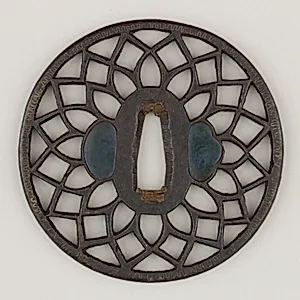
Sword Guard (Tsuba)
Unknown Artist
17th century
Medium
Iron, copper
Dimensions
Diam. 3 5/16 in. (8.4 cm); thickness 3/16 in. (0.5 cm); Wt. 4.1 oz. (116.2 g)
Classification
Sword Furniture-Tsuba
Culture
Japanese
Department
Arms and Armor
Museum
Metropolitan Museum of Art, New York, NY
Credit
Gift of Mrs. Adrian H. Joline, 1914
Accession Number
14.60.38
Rights
Public Domain
Art Historical Context
This exquisite 17th-century Japanesetsuba*, or sword guard, is a masterful example of functional art from the Edo period (1603–1868). Positioned on a samurai katana between the blade and handle, the tsuba protected the wielder's hand while serving as a canvas for intricate designs. During this time of relative peace under the Tokugawa shogunate, sword fittings evolved from purely utilitarian objects into symbols of status and refined craftsmanship, blending martial tradition with artistic expression. Craft from iron inlaid or overlaid with copper, this tsuba exemplifies advanced metalworking techniques like piercing, chiseling, and patination, which created both strength and aesthetic appeal. Measuring 3 5/16 inches (8.4 cm) in diameter and weighing 4.1 ounces (116.2 g), its modest thickness of 3/16 inch (0.5 cm) highlights the precision required for balance and durability. Such pieces were often customized for high-ranking warriors or collectors, reflecting Zen-inspired motifs or nature themes common in Japanese arms and armor. A generous gift to the Metropolitan Museum of Art from Mrs. Adrian H. Joline in 1914, this anonymous artwork invites us to appreciate the harmony of form and function in samurai culture—where every detail told a story of discipline and beauty.