
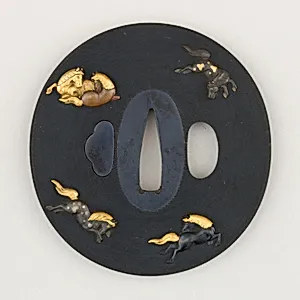
Sword Guard (Tsuba)
Unknown Artist
19th century
Medium
Copper-gold alloy (shakudō), gold, copper, bronze
Dimensions
H. 3 1/8 in. (7.9 cm); W. 2 15/16 in. (7.5 cm); thickness 5/16 in. (0.8 cm); Wt. 6.3 oz. (178.6 g)
Classification
Sword Furniture-Tsuba
Culture
Japanese
Department
Arms and Armor
Museum
Metropolitan Museum of Art, New York, NY
Credit
Gift of Mrs. Adrian H. Joline, 1914
Accession Number
14.60.79
Rights
Public Domain
Tags
Art Historical Context
This exquisite **Sword Guard (Tsub)** from 19th-century Japan exemplifies the masterful metalwork of samurai sword fittings. Crafted from shakudō—a copper-gold alloy prized for its deep, velvety black patina chemically treated—along with inlays of gold, copper, and bronze, it measures a compact 3 1/8 by 2 15/16 inches. As part of a katana's hilt assembly, the tsuba served both a practical purpose, shielding the hand from an opponent's blade, and an artistic one, showcasing the wearer's status and taste. The design likely features dynamic horses, a motif symbolizing speed, power, and nobility in Japanese culture, often evoking warrior ideals or equestrian prowess. Artisans employed intricate techniques like nunome-zogan (gold inlay hammered into etched patterns) to create vivid contrasts against the shakudō ground, reflecting the refined Goto school traditions or similar late Edo/Meiji workshops. By the 19th century, as samurai culture waned amid modernization, such tsuba became prized collector's items, blending functionality with poetic artistry. A gift to the Metropolitan Museum of Art in 1914 from Mrs. Adrian H. Joline, this piece invites visitors to appreciate Japan's enduring legacy in arms and armor—where every curve and gleam tells a story of discipline and beauty.