
Sword Guard (Tsuba)
Unknown Artist
18th century
Medium
Lacquer (maki-e), wood, mother-of-pearl, coral, agate, ivory, tortoiseshell, pewter, copper
Dimensions
H. 3 7/8 in. (9.8 cm); W. 3 1/2 in. (8.9 cm); thickness 3/8 in. (1 cm); Wt. 2.8 oz. (79.4 g)
Classification
Sword Furniture-Tsuba
Culture
Japanese
Department
Arms and Armor
Museum
Metropolitan Museum of Art, New York, NY
Credit
Bequest of Edward G. Kennedy, 1932
Accession Number
33.40.2
Rights
Public Domain
Tags
Art Historical Context
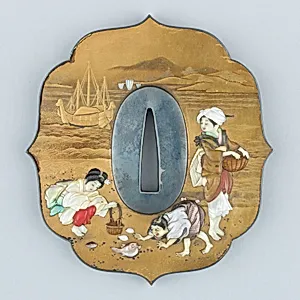
This exquisite 18th-century Japanese guard, or *tsuba*, served as the protective handguard on a samurai, blending functionality with stunning artistry. Crafted during the Edo period, a time of relative peace when martial arts evolved into refined cultural expressions, *tsuba* became coveted objects of personal style. Adorning katana or wakizashi blades, they showcased the wearer's taste and status, transforming weapons into wearable art. The *tsuba* gleams with masterful *maki-e* lacquer technique, where powdered gold or silver is sprinkled onto wet lacquer for a shimmering effect, then inlaid with luxurious materials like mother-of-pearl, coral, agate, ivory, tortoiseshell, pewter, and copper. Vivid motifs of birds, women, fish, flowers, and ships evoke a lively seascape or seasonal narrative, common in Japanese decorative arts symbolizing harmony with nature and life's fleeting beauty. At just under 4 inches tall, its compact form belies the intricate craftsmanship required. Bequeathed to the Metropolitan Museum of Art in 1932 by Edward G. Kennedy, this piece highlights Japan's legacy in arms and armor as high art, inviting us to appreciate the samurai's world through opulent detail and poetic imagery.