
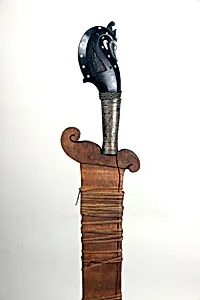
Sword (Klewang) with Scabbard
Unknown Artist
18th–19th century
Medium
SIlver, bone
Dimensions
L. with scabbard 28 in. (71.1 cm); L. without scabbard 25 1/2 in. (64.8 cm); L. of blade 18 in. (45.7 cm); W. 2 1/2 in. (6.4 cm); Wt. 1 lb. 8.3 oz. (688.9 g); Wt. of scabbard 9.2 oz. (260.8 g)
Classification
Swords
Culture
Malayan
Department
Arms and Armor
Museum
Metropolitan Museum of Art, New York, NY
Credit
Bequest of George C. Stone, 1935
Accession Number
36.25.1516a, b
Rights
Public Domain
Art Historical Context
This elegant klewang sword with its scabbard exemplifies the masterful craftsmanship of 18th–19th Malayan arms makers. Housed in the Metropolitan Museum of Art's and Armor Department (bequest of George C. Stone, 1935), the weapon measures 28 inches long with its scabbard and weighs just over 1.5 pounds total. Crafted from silver and bone, its hilt and sheath likely feature intricate inlays or carvings—common in Malay sword-making to blend functionality with aesthetic appeal. The broad 18-inch blade, tapering to a sharp point, was designed for slashing in close combat. In Malayan culture of the Southeast Asian archipelago, the klewang was a versatile sidearm favored by warriors, pirates, and nobility during eras of trade, conflict, and colonial encounters. Silver accents denoted status, while bone grips provided a secure, lightweight hold suited to the humid tropics. These swords were not mere tools of war but symbols of prowess, often personalized with motifs reflecting Islamic influences or animistic beliefs prevalent in the region. Today, this piece invites us to ponder the artistry in weaponry—where lethal precision meets ornamental beauty—offering a tangible link to Malay heritage and the global history of edged arms.