
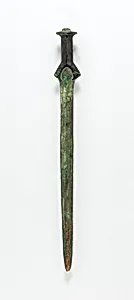
Sword of the Achtkantschwert Type
Unknown Artist
13th century BCE
Medium
Bronze
Dimensions
L. 20 1/2 in. (52 cm); W. 1 15/16 in. (4.9 cm); Wt. 1 lb. 3.7 oz. (558.5 g)
Classification
Swords
Culture
probably Central European
Department
Arms and Armor
Museum
Metropolitan Museum of Art, New York, NY
Credit
Gift of Malcolm Wiener, 2015
Accession Number
2015.758.2
Rights
Public Domain
Art Historical Context
Step into the Bronze Age with *Sword of the Achtantschwert Type*, remarkable bronze weapon likely crafted in Central Europe during the 13th century BCE. Measuring 20½ inches (52 cm) in length weighing just over a pound (558.5 g), this sword exemplifies the era's metallurgical prowess. The "Achtkantschwert" refers to its distinctive octagonal (achtkant) features, possibly in the hilt or blade cross-section, a hallmark of sword typology that aided balance and grip during combat. Forged from bronze—a copper-tin alloy that revolutionized weaponry—this sword was more than a tool of war; it symbolized status and power among elite warriors. In Central Europe's Late Bronze Age, such blades were cast using lost-wax techniques, enabling intricate designs while ensuring durability for thrusting and slashing. Archaeological parallels suggest these swords circulated through trade networks, from the Danube region to the Alps, reflecting interconnected Bronze Age societies amid rising conflict and migration. Today, this gift from Malcolm Wiener (2015) at The Metropolitan Museum of Art invites us to ponder the hands that wielded it—perhaps a chieftain defending hill forts. Though its maker remains unknown, the sword's survival speaks to the enduring legacy of ancient craftsmanship.