
Sword with Scabbard
Unknown Artist
18th–19th century
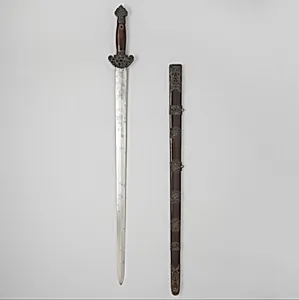
Medium
Steel, silver, wood
Dimensions
L. with scabbard 41 3/4 in. (106 cm); L. without scabbard 40 7/8 in. (103.8 cm); L. of blade 33 in. (83.8 cm); W. 3 3/4 in. (9.5 cm); Wt. 2 lb. 2.9 oz. (989.4 g); Wt. of scabbard 13.8 oz. (391.2 g)
Classification
Swords
Culture
Chinese
Department
Arms and Armor
Museum
Metropolitan Museum of Art, New York, NY
Credit
Bequest of George C. Stone, 1935
Accession Number
36.25.1486a, b
Rights
Public Domain
Art Historical Context
This elegant Chinese sword with scabbard, dating to the 18th–19th century, exemplifies masterful craftsmanship of Qing Dynasty arms makers. Crafted from steel for its razor-sharp 33-inch blade, with silver fittings and wooden elements for the hilt and sheath, the weapon measures an imposing 41¾ inches overall and weighs just over 2 pounds without its scabbard. Such precise dimensions reflect its dual role as both a functional combat tool and a status symbol, balancing lethality with portability for mounted warriors or officials. In Chinese culture, swords like this—likely a dao or jian type—held profound symbolic power, representing martial prowess, imperial authority, and Confucian ideals of righteousness. During the Qing era, they were essential for military campaigns, self-defense, and ceremonial displays among the elite. The use of silver for decorative mounts highlights advanced metalworking techniques, where artisans hammered and chased intricate patterns to evoke prestige without sacrificing durability. Now housed in the Metropolitan Museum of Art's Arms and Armor Department through the bequest of collector George C. Stone in 1935, this sword invites us to ponder the blend of artistry and warfare in imperial China, a testament to an era when beauty and battle were inextricably linked.