
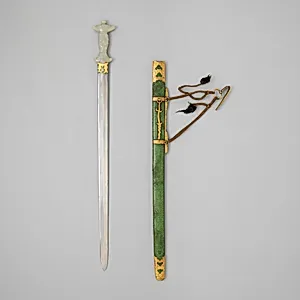
Sword with Scabbard
Unknown Artist
19th century
Medium
Steel, jade, bronze, sharkskin, textile, wood, gold
Dimensions
L. with scabbard 28 3/4 in. (73 cm); L. without scabbard 27 1/2 in. (69.9 cm); W. 2 1/2 in. (6.4 cm); Wt. 14.2 oz. (402.6 g); Wt. of scabbard 8 oz. (226.8 g)
Classification
Swords
Culture
Chinese
Department
Arms and Armor
Museum
Metropolitan Museum of Art, New York, NY
Credit
The Collection of Giovanni P. Morosini, presented by his daughter Giulia, 1932
Accession Number
32.75.308a, b
Rights
Public Domain
Art Historical Context
This exquisite 19th-century Chinese sword withabbard exemplifies the masterful craftsmanship of Qing Dynasty arms, blending functionality with opulent decoration. Crafted from steel for the blade, with a hilt and fittings of jade, bronze, and gold, the weapon features a grip wrapped in sharkskin for superior hold and a scabbard of wood, textile, and lavish materials. Measuring 28¾ inches (73 cm) overall and weighing just over a pound (402.6 g) without its 8-ounce (226.8 g) sheath, it strikes a balance between portability and presence, ideal for a mounted warrior or high-ranking official. In Chinese culture, such swords transcended mere weaponry, symbolizing authority, moral virtue, and imperial prestige. The lavish use of jade—revered for its purity and association with heaven—and gold highlights its status as a ceremonial or elite object, likely owned by nobility rather than common soldiers. Techniques like precise steel forging and intricate inlays reflect advanced metallurgical and decorative arts honed over centuries. Acquired through the renowned Giovanni P. Morosini Collection and gifted to the Metropolitan Museum of Art in 1932, this sword offers a window into China's martial elegance, inviting visitors to ponder the lives of those who once bore it.