
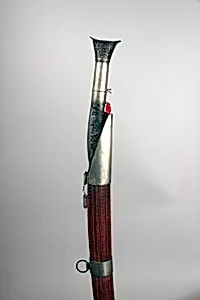
Sword (Yatagan) with Scabbard
Unknown Artist
19th century
Medium
Steel, silver, wood, lacquer
Dimensions
L. with scabbard 29 1/2 in. (74.9 cm); L. without scabbard 26 5/8 in. (67.6 cm); W. 2 in. (5.1 cm); Wt. 1 lb. 0.2 oz. (459.3 g); Wt. of scabbard 13.5 oz. (382.7 g)
Classification
Swords
Culture
Turkish
Department
Arms and Armor
Museum
Metropolitan Museum of Art, New York, NY
Credit
Bequest of George C. Stone, 1935
Accession Number
36.25.1334a, b
Rights
Public Domain
Art Historical Context
This elegant yatagan sword with scabbard exemplifies 19th-century Turkish arms craftsmanship from the Ottoman Empire. The yatagan, a distinctive single-edged blade with a dramatic upswept tip and integrated hilt—lacking a traditional crossguard—was favored by Ottoman infantry and cavalry for its balance and slashing power. Measuring nearly 30 inches with its scabbard, this weapon combines functionality with artistry, reflecting the martial culture of the era when such swords symbolized status and valor. Crafted from steel for the blade, adorned with silver, and featuring a wooden scabbard coated in lacquer, the piece showcases intricate metalworking techniques like gilding or inlay, common in Turkish arms. These materials not only ensured durability in battle but also elevated the sword to a status object, often gifted or displayed ceremonially. Weighing just over a pound without its scabbard, it was light yet lethal, ideal for close combat. Acquired through the 1935 bequest of George C. Stone to the Metropolitan Museum of Art's Arms and Armor Department, this yatagan offers a window into Ottoman artistry amid the empire's waning years, blending lethal utility with refined decoration.