
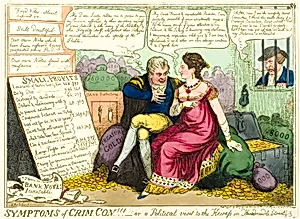
Symptoms of Crim. Con!!
published February 12, 1819
Medium
Hand-colored etching on paper
Dimensions
Image: 22.5 × 32 cm (8 7/8 × 12 5/8 in.); Sheet cut within platemark: 24.7 × 33 cm (9 3/4 × 13 in.)
Classification
etching
Department
Prints and Drawings
Museum
Art Institute of Chicago
Accession Number
89912
Rights
Public Domain
Art Historical Context
Isaac Robert Cruikshank’s *Symptoms of Crim. Con!!*, published in February 1819, offers a lively glimpse into the satirical print culture of Regency-era Britain. As a hand-colored etching, the work belongs to a tradition of affordable, widely circulated imagery that allowed artists to comment on the scandals and social follies of the day. “Crim. Con.” was contemporary shorthand for “criminal conversation,” the legal term for adultery, suggesting the print pokes fun at the telltale signs and consequences of romantic indiscretion. Cruikshank, part of a prominent family of British caricaturists, used the etching technique to create sharp lines and expressive figures that could be quickly hand-tinted for dramatic effect. These prints were popular in shop windows and private collections, serving both as entertainment and as subtle social critique. By capturing the era’s fascination with gossip and moral lapses among the fashionable classes, the work reflects how art helped shape public conversation about propriety and reputation in early nineteenth-century London.