
Syrup Jug
Unknown Artist
1830–70
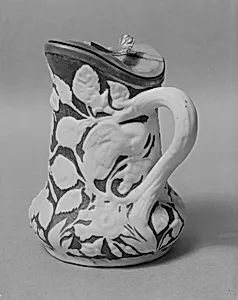
Medium
Parian porcelain, pewter
Dimensions
4 7/8 x 4 3/8 x 3 5/8 in. (12.4 x 11.1 x 9.2 cm)
Classification
Syrup jug
Culture
American
Department
The American Wing
Museum
Metropolitan Museum of Art, New York, NY
Credit
Gift of Dr. Charles W. Green, 1947
Accession Number
47.90.95
Rights
Public Domain
Tags
Art Historical Context
This delicate **Syrup Jug**, crafted between 1830 and 1870, exemplifies mid-19th-century American decorative arts housed in The American Wing of the Metropolitan Museum Art. Made of Parian porcelain—a fine, unglazed bisque porcelain prized for its matte, marble-like sheen—the jug measures a compact 4 7/8 x 4 3/8 x 3 5/8 inches, perfect for tabletop use. Its pewter elements, likely the lid or spout, add durability and a subtle gleam, blending the elegance of porcelain with practical metalwork common in American households of the era. Parian ware, inspired by the translucent Parian marble of Greek sculptures, surged in popularity in the United States during this period, produced by potteries seeking affordable luxury. Leaf motifs, suggested by the object's tags, evoke nature's abundance, a recurring theme in American design reflecting the young nation's agrarian roots and growing interest in neoclassical refinement. As a functional yet ornamental piece, it highlights how everyday items like syrup pitchers became status symbols, gracing breakfast tables amid the Industrial Revolution's rise. Gifted to the Met in 1947 by Dr. Charles W. Green, this anonymous artist's creation offers a glimpse into domestic life, where artistry met utility. Visitors, imagine pouring maple syrup from its graceful form— a sweet testament to America's inventive spirit!