
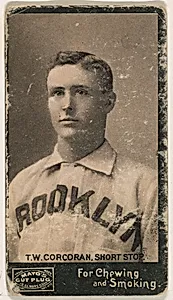
T.W. Corcoran, Shortstop, Brooklyn, from Mayo's Cut Plug Baseball series (N300)
Medium
Commercial lithograph
Dimensions
Sheet: 2 13/16 × 1 5/8 in. (7.2 × 4.1 cm)
Classification
Prints|Ephemera
Department
Drawings and Prints
Museum
Metropolitan Museum of Art, New York, NY
Credit
The Jefferson R. Burdick Collection, Gift of Jefferson R. Burdick
Accession Number
Burdick 222, N300.34
Rights
Public Domain
Tags
Art Historical Context
Step into the vibrant world of 1890s America with *T.W. Corcoran, Shortstop, Brooklyn*, a charming commercial lithograph from P.H. Mayo & Brother's Mayo's Cut Plug Baseball series (N300). Produced in Richmond, Virginia, in 1895, this tiny print—measuring just 2 13/16 × 1 5/8 inches—captures the poised figure of baseball player T.W. Corcoran, a key shortstop for the Brooklyn team. As part of the Drawings and Prints department at The Metropolitan Museum of Art, gifted through The Jefferson R. Burdick Collection, it exemplifies ephemera: everyday printed matter that offers a window into popular culture. Lithography, the medium here, was a game-changer for mass production, enabling tobacco companies like Mayo's to insert these colorful athlete portraits into cigarette packages as promotional "premiums." This series fueled the early trading card craze, blending advertising savvy with the rising mania for baseball, America's burgeoning national pastime. At a time when professional leagues were professionalizing amid the Gilded Age's economic boom, such cards immortalized stars like Corcoran, turning sports heroes into household names and sparking collecting fever among fans, especially boys. Today, this unassuming gem highlights the intersection of commerce, sport, and visual culture, reminding us how everyday objects preserved the thrill of 19th-century athletics. A true piece of history in your pocket—or museum case!