
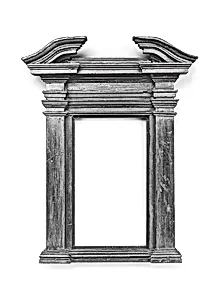
Tabernacle frame
Unknown Artist
style late 16th century, made 19th century
Medium
Walnut
Dimensions
Overall: 20 13/16 × 16 1/8 in. (52.8 × 41 cm) Sight: 12 1/16 × 6 3/4 in. (30.6 × 17.2 cm) Rabbet: 12 5/8 × 7 5/16 in. (32 × 18.5 cm)
Classification
Frames
Culture
Italian, Tuscan
Department
Robert Lehman Collection
Museum
Metropolitan Museum of Art, New York, NY
Credit
Robert Lehman Collection, 1975
Accession Number
1975.1.2155
Rights
Public Domain
Art Historical Context
This exquisite *Tabernacle frame* from, Italy, exemplifies the enduring appeal of late 16th-century Renaissance, though crafted in the 19th. Tabernacle frames, named for their resemblance to sacred niches or aedicules, were originally popular for enclosing devotional paintings or small altarpieces, creating an architectural illusion that elevates the artwork within a miniature shrine-like structure. Its Tuscan origins tie it to the rich tradition of Florentine and Sienese craftsmanship, where were not mere supports but integral elements of artistic presentation. Fashioned from richly grained walnut—a durable, prized wood in Italian woodworking—the frame measures 20 13/16 × 16 1/8 inches overall, with a sight opening of 12 1/16 × 6 3/4 inches, ideal for intimate religious icons or portraits. The 19th-century creation reflects a revivalist spirit, when collectors and artists sought to recapture the grandeur of the Renaissance amid Romantic nostalgia for the past. Housed in the Robert Lehman Collection at The Metropolitan Museum of Art since 1975, it highlights how frames preserve cultural heritage, bridging centuries of aesthetic evolution. Visitors will appreciate its tactile warmth and precise joinery, a testament to Tuscan mastery that invites closer inspection in the museum's galleries.