
Tabl Sami
Unknown Artist
late 19th century
Medium
Wood
Dimensions
Depth 3 13/16 × Diam.: Head 12 3/16 × Base 5 13/16 in. (9.7 × 31 × 14.8 cm)
Classification
Membranophone-single-headed / goblet drum
Culture
Arabian
Department
Musical Instruments
Museum
Metropolitan Museum of Art, New York, NY
Credit
The Crosby Brown Collection of Musical Instruments, 1889
Accession Number
89.4.386
Rights
Public Domain
Art Historical Context
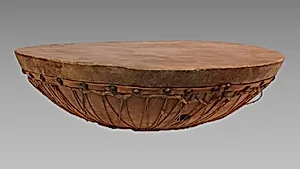
The object shown is a wooden goblet drum viewed from above and slightly to the side. Its broad, circular head is covered with a single sheet of light-brown hide that shows subtle creases and wear from use. Around the rim, a band of leather secures the head with evenly spaced metal studs, while thin cords laced in a repeating V-pattern descend the flared wooden body, anchoring the tensioning system. The wood itself has a warm, natural tone and visible grain, with the narrower base cut straight across to rest on a surface. This instrument is catalogued as a Tabl Sami, a single-headed membranophone from Arabian culture. Acquired by The Metropolitan Museum of Art in 1889 as part of the Crosby Brown Collection, it dates to the late nineteenth century and is constructed primarily of wood. Such drums were valued for their resonant tone and portability, serving both in ensemble music and solo performance across the Arabian Peninsula. The visible lacing and stud construction illustrate traditional methods of attaching and tuning the head, techniques that allowed players to adjust pitch by tightening the cords. Its presence in the museum’s musical-instrument holdings underscores the long-standing role of percussion in the region’s artistic heritage.