
Table
Unknown Artist
1650–1700
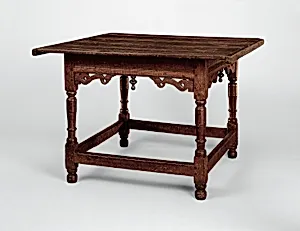
Medium
Oak, pine
Dimensions
26 1/2 x 42 x 42 in. (67.3 x 106.7 x 106.7 cm)
Classification
Table
Culture
American
Department
The American Wing
Museum
Metropolitan Museum of Art, New York, NY
Credit
Gift of Mrs. Russell Sage, 1909
Accession Number
10.125.105
Rights
Public Domain
Art Historical Context
This sturdy oak and pine table, crafted by an unknown American artisan between 1650 and 1700, exemplifies the practical elegance of early colonial furniture. Measuring a generous 26½ x 42 x 42 inches, its square form and modest height suggest it served as a multifunctional centerpiece in a 17th-century household—ideal for dining, work, or gatherings in the tight-knit communities of New England or the Mid-Atlantic colonies. The use of oak for strength and pine for lighter, more workable elements highlights the resourcefulness of colonial woodworkers, who relied on abundant local hardwoods without imported luxuries. In the context of American history, such tables reflect the transition from rudimentary settler furnishings to more refined joinery techniques, like pegged joints and simple turnings, which prioritized durability over ornamentation. This piece captures the era's Puritan restraint and self-sufficiency, where every object was built to last amid frontier hardships. Donated to the Metropolitan Museum of Art in 1909 by Mrs. Russell Sage, it now anchors The American Wing, offering visitors a tangible link to the everyday lives of America's founding generations.