
Table clock
17th century
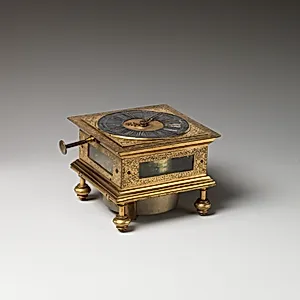
Medium
Brass, silver
Dimensions
Overall: 3 × 5 1/4 × 4 in. (7.6 × 13.3 × 10.2 cm)
Classification
Horology
Culture
German
Department
European Sculpture and Decorative Arts
Museum
Metropolitan Museum of Art, New York, NY
Credit
Gift of Mrs. Simon Guggenheim, 1929
Accession Number
29.52.2
Rights
Public Domain
Art Historical Context
This exquisite 17th-century table, crafted by the skilled German clockmaker Johann Heinrichinschmidt, exemplifies pinnacle of Baroque-era horology. Measuring just 3 × 5¼ × 4 inches, its compact brass and silver form was designed for placement on a gentleman's desk or mantel, blending functionality with opulent decoration. The use of silver—often gilded or engraved—highlights the luxury accessible only to the elite, while durable brass ensured precise timekeeping mechanisms that were marvels of mechanical ingenuity. In the context of 17th-century Europe, German clockmakers like Kleinschmidt advanced the science of horology amid the Renaissance's lingering influence and the rise of scientific inquiry. These table clocks represented not just timepieces but status symbols, showcasing intricate gears, balances, and possibly striking mechanisms that chimed the hours. Housed in the Metropolitan Museum of Art's Department of European Sculpture and Decorative Arts, this piece—generously gifted by Mrs. Simon Guggenheim in 1929—offers a window into the era's fusion of artistry and engineering. Visitors will appreciate how such diminutive wonders captured the fleeting nature of time, reflecting a culture where precision craftsmanship intertwined with aesthetic splendor. A true gem of Germanic decorative arts!