
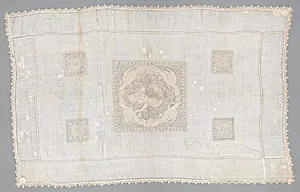
Table cover
Unknown Artist
16th century
Medium
Linen, embroidered net
Dimensions
L. 78 1/2 x W. 47 inches 199.4 x 119.4 cm
Classification
Textiles-Laces
Culture
Italian, possibly Sicily
Department
European Sculpture and Decorative Arts
Museum
Metropolitan Museum of Art, New York, NY
Credit
The Mabel Metcalf Fahnestock Collection, the gift of Ruth Fahnestock Schermerhorn and Faith Fahnestock, 1933
Accession Number
33.90.7
Rights
Public Domain
Art Historical Context
This exquisite 16th-century table cover, crafted from linen embroidered net, hails from Italy—possibly Sicily—and measures an impressive 78½ by 47 inches (199.4 x 119.4 cm). Now housed in the Metropolitan Museum of Art's Department of European Sculpture and Decorative Arts as part of The Mabel Metcalf Fahnestock Collection (gifted in 1933), it exemplifies the era's mastery of textile craftsmanship. Such large-scale pieces were prized possessions in Renaissance households, adorning dining tables to showcase wealth and refinement during lavish meals and gatherings. The medium reveals sophisticated techniques: a fine linen net ground densely embroidered to create intricate patterns, a precursor to later bobbin laces. In 16th-century Italy, particularly in regions like Sicily with its vibrant textile traditions influenced by Mediterranean trade, these embroidered nets (known as reticella or early punto in aria styles) bridged embroidery and lace-making. Artisans meticulously cut and darned threads to form geometric motifs, demanding patience and skill that rivaled painting or sculpture. As a "Textiles-Laces" classification item, this anonymous work highlights the unsung artistry of female workshops and convents, where such covers symbolized piety, status, and cultural exchange. Visitors will appreciate its delicate translucency and scale, a tangible link to Renaissance daily luxury.