
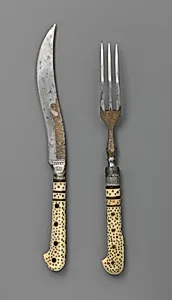
Table knife and fork
Unknown Artist
19th century
Medium
Steel, bone
Dimensions
Length (knife .48): 6 5/8 in. (16.8 cm); Length (fork .49): 6 1/8 in. (15.6 cm)
Classification
Metalwork-Steel
Culture
Serbian
Department
European Sculpture and Decorative Arts
Museum
Metropolitan Museum of Art, New York, NY
Credit
Gift of R. Stuyvesant, 1891
Accession Number
91.16.48, .49
Rights
Public Domain
Art Historical Context
Nestled in the Metropolitan Museum of Art's European Sculpture and Decorative Arts collection, this pair of 19th-century table knife and fork exemplifies everyday metalwork from the Balkans. Crafted from steel blades and bone handles the knife measures 6 5/8 inches (16.8 cm) long, while the fork is slightly shorter at 6 1/8 inches (15.6 cm). Donated in 1891 by R. Stuyvesant, these unassuming utensils highlight the practical artistry of anonymous Serbian craftsmen during a transformative era. In 19th-century Serbia, emerging from Ottoman rule toward independence in 1878, such steel and bone implements were staples of rural and urban tables. The bone grips—likely sourced from local animals—provided a comfortable, insulating hold against the forged steel blades, blending functionality with subtle elegance. This combination reflects traditional Balkan metalworking techniques, where blacksmiths hammered and shaped steel for durability, often engraving or polishing for refinement. Though created by an unknown artist, these pieces offer a window into Serbia's cultural heritage, showcasing how decorative arts intertwined with daily life. Their preservation at the Met underscores the value of humble objects in telling broader stories of craftsmanship and resilience.