
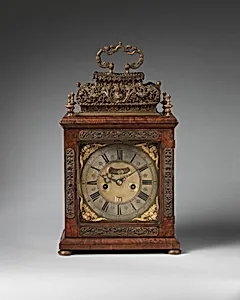
Table or bracket clock
1690
Medium
Gilded brass and steel; Case: walnut, walnut veneer, and gilded brass
Dimensions
Overall: 15 1/2 × 10 × 6 1/2 in. (39.4 × 25.4 × 16.5 cm)
Classification
Horology
Culture
British, London
Department
European Sculpture and Decorative Arts
Museum
Metropolitan Museum of Art, New York, NY
Credit
Gift of Irwin Untermyer, 1964
Accession Number
64.101.861
Rights
Public Domain
Art Historical Context
This exquisite table or bracket clock, by London clockmaker John Andrews in1690, exemplifies the of British horology during the late 17th century. a compact 15½ × 10 × 6½ inches, it was designed for portability—ideal for placement on a gentleman's desk or mounted on a wall bracket in a grand country house. As a luxury timepiece from the William and Mary era, it reflects the era's fascination with scientific precision and opulent domestic display, when accurate timekeeping became a status symbol amid England's growing mercantile prosperity. The clock's movement, fashioned from gilded brass and steel, showcases Andrews' mastery of intricate gearwork and balance springs, innovations that improved reliability over earlier verge escapements. Its walnut case, enhanced with matching veneer and ornate gilded brass mounts, blends English oak-inspired warmth with continental baroque flair, likely influenced by Huguenot craftsmen fleeing France. These materials not only protected the delicate mechanism but elevated the clock to a work of decorative art. Housed in the Metropolitan Museum of Art's European Sculpture and Decorative Arts department (gift of Irwin Untermyer, 1964), this piece offers a window into how timepieces bridged functionality and fine craftsmanship, adorning the homes of the elite while advancing the craft that would define modern watchmaking.