
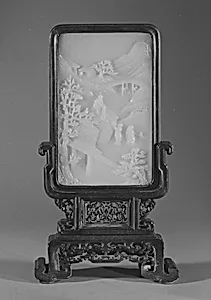
玉插屏|Table Screen
Unknown Artist
18th century
Medium
Nephrite, wood
Dimensions
H. 6 in. (15.2 cm); H. (with stand) 9 in. (22.9 cm); W. 5 in. (12.7 cm)
Classification
Jade
Culture
China
Department
Asian Art
Museum
Metropolitan Museum of Art, New York, NY
Credit
Alfred W. Hoyt Collection, Bequest of Rosina H. Hoppin, 1965
Accession Number
65.86.197a, b
Rights
Public Domain
Art Historical Context
This exquisite **Table Screen (玉插屏)**, crafted in 18th-century China, exemplifies the refined artistry of the Qing dynasty. Made from nephrite jade—a tough, translucent green stone revered in Chinese culture for over 7,000 years—the screen is mounted on a wooden stand Standing about 9 inches tall with its base, it served as a elegant desk accessory for scholars and elites, shielding writing surfaces from drafts while adding a touch of natural beauty to scholarly studios or ancestral altars. Nephrite jade held profound symbolic value, embodying purity, immortality, and imperial virtue; its carving demanded masterful skill to reveal the stone's inherent luster without flaws. Though the artist's identity is unknown, such pieces reflect the era's peak in jade craftsmanship, where artisans transformed raw boulders into delicate screens through meticulous incising and polishing. Often paired with inscriptions or motifs evoking nature and virtue, these objects underscored the literati's harmony with the cosmos. Housed in the Metropolitan Museum of Art's Asian Art collection (Alfred W. Hoyt Collection, Bequest of Rosina H. Hoppin, 1965), this screen invites us to appreciate jade's enduring allure—a bridge between heaven and earth in Chinese aesthetics.